

Executive Director & Co-Founder
Bio Supply Management Alliance (BSMA)
Executive Director & Co-Founder
Bio Supply Management Alliance (BSMA)
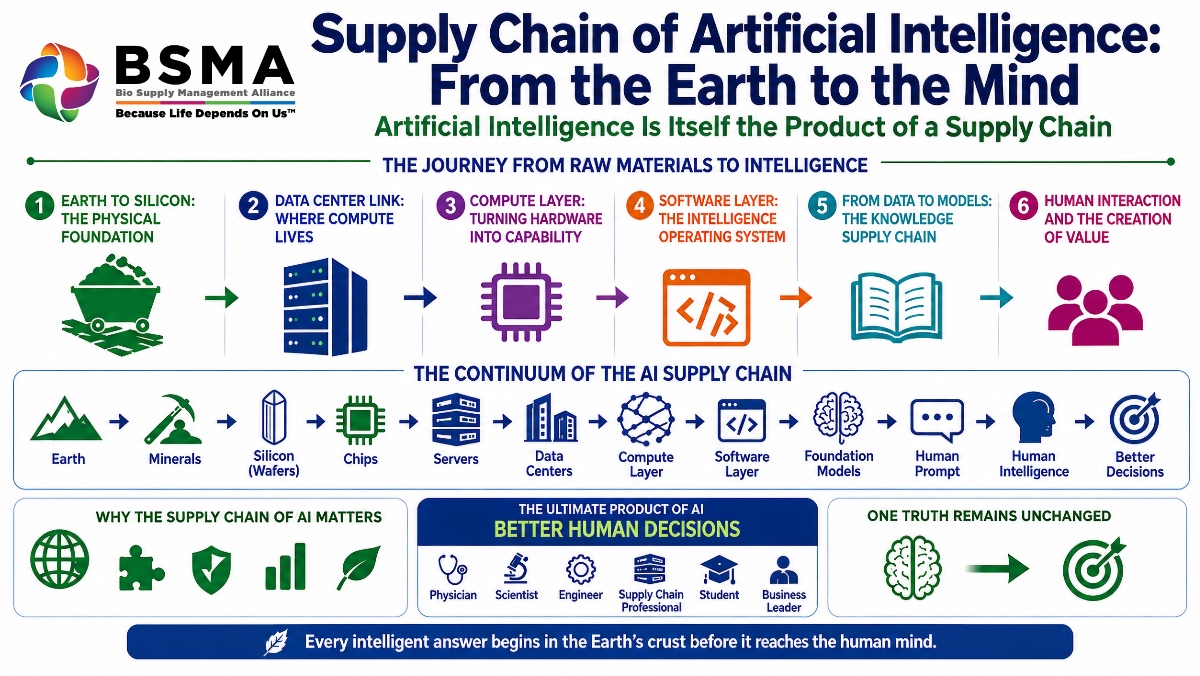
Every stage depends on the flawless execution of the preceding one. The true output of Artificial Intelligence is not text or software, it is better human decision-making. AI creates value only when it enables physicians to improve patient care, scientists to accelerate discovery, engineers to design better systems, supply chain professionals to prevent shortages, students to learn more effectively, and business leaders to make wiser decisions.
Without resilient, secure, and globally integrated supply chains, there would be no advanced chips, no frontier AI models, and no intelligent systems. As AI advances from today’s Large Language Models toward increasingly capable reasoning systems and ultimately Artificial General Intelligence (AGI), one reality will remain constant: the future of intelligence will depend upon the future of supply chains.
The journey starts with minerals. Silica, copper, aluminum, gold, cobalt, nickel, lithium, rare earth elements, and dozens of other materials are extracted, refined, and transported across continents. These raw materials become the foundation of semiconductors, power systems, networking equipment, and the infrastructure upon which artificial intelligence depends. Silica is transformed into ultra-pure silicon. Silicon becomes wafers. Wafers become advanced semiconductor chips. Those chips are assembled into servers, connected through high-speed networks, and deployed in vast data centers containing tens of thousands of processors working in parallel. These facilities require far more than computing hardware. They depend upon enormous supplies of electricity, sophisticated cooling systems, reliable water resources, fiber-optic communications, cybersecurity, and highly skilled engineers. Every component must function with extraordinary precision and reliability. Yet hardware alone does not create intelligence.
The next stage of the supply chain is knowledge itself. Scientific literature, books, software code, publicly available information, licensed content, and countless other sources become the raw material from which frontier AI models learn patterns, relationships, and reasoning. This knowledge is processed through immense computational effort over weeks or months, consuming millions of processor hours to produce a trained foundation model. The trained model is then distributed through global cloud infrastructure where it becomes available to millions of users. Finally, a person asks a question. The prompt travels through communication networks to a data center, where thousands of processors perform trillions of mathematical calculations within seconds. The resulting response returns to the user almost instantaneously.
At first glance, it appears that the supply chain ends there but it does not. The answer has value only when it enables a physician to make a better diagnosis, a scientist to discover a new therapy, an engineer to design a better product, a supply chain professional to prevent a shortage, a student to learn, or a business leader to make a wiser decision. The ultimate product of Artificial Intelligence is not text. It is better human decisions.
Viewed from this perspective, the supply chain of Artificial Intelligence is remarkably elegant: Earth → Minerals → Silicon → Chips → Servers → Data Centers → Foundation Models → Human Prompt → Human Intelligence → Better Decisions. This continuum reminds us that AI is not merely a software revolution. It is the convergence of natural resources, manufacturing, engineering, logistics, energy, communications, knowledge, and human creativity. Every stage depends upon the flawless execution of the one before it. The discussion surrounding Artificial Intelligence often centers on algorithms, ethics, regulation, or computational capability. These are undeniably important. Yet beneath them lies an invisible infrastructure that makes intelligence possible. That infrastructure is the supply chain. Just as supply chains have long served as the operating system of economies, they have now become the operating system of Artificial Intelligence itself. Without resilient, secure, and globally integrated supply chains, there would be no advanced chips, no data centers, no frontier models, and no AI.