

Executive Director & Co-Founder
Bio Supply Management Alliance (BSMA)
Executive Director & Co-Founder
Bio Supply Management Alliance (BSMA)
And the end of all our exploring
Will be to arrive where we started
And know the place for the first time.”
:- T. S. Eliot, Little Gidding, Four Quartets
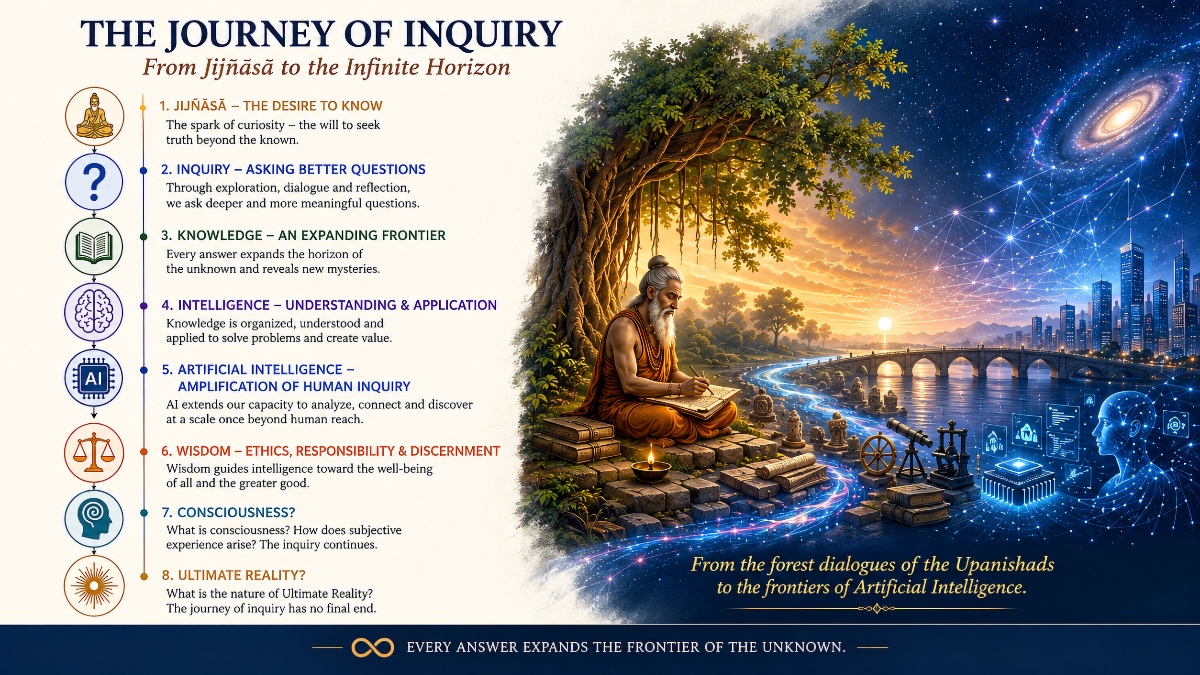
For thousands of years, Hindu philosophical traditions, particularly the Upanishads, Vedanta, Nyaya, and Sankhya, have cultivated Jijñāsā, the disciplined pursuit of knowledge through continuous questioning.
Although Artificial Intelligence is fundamentally computational rather than conscious, its prompt-driven architecture exhibits a structural resonance with this recursive tradition of inquiry. Better questions produce deeper understanding, which in turn generates new questions. The paper argues that AI should be viewed not merely as a technological revolution but as humanity’s newest instrument of inquiry.
It concludes by suggesting that the next frontier of AI may not simply be more powerful computation, but a deeper exploration of consciousness itself—a question that remains open to science, philosophy, and spirituality alike.
Among these strands of Hindu philosophy, particularly the inquiry-centered traditions of the Upanishads, Vedanta, Nyaya, and Sankhya, provide a compelling framework which comes naturally to me (1). These traditions emphasize recursive questioning, epistemic plurality, disciplined exploration, and the expansion of understanding rather than doctrinal closure. Hindu inquiry traditions may serve as a sophisticated philosophical lens through which to examine prompt-driven AI systems, offering comparative insight into iterative knowledge generation while also contributing ethical and civilizational depth to debates about AI’s future.
Artificial Intelligence is transforming our world with astonishing speed where discussions about AI typically center on algorithms, computing power, semiconductors, regulation, and economic disruption (2). These are essential conversations, yet they leave unanswered a more fundamental question: How should humanity understand intelligence itself? Before this is a technological question, it is a philosophical one. Among the world’s great philosophical traditions, Hinduism offers a remarkably relevant perspective—not because it predicted artificial intelligence, but because it cultivated one of humanity’s oldest and most enduring traditions of inquiry. Its contribution lies in teaching us how to seek knowledge. As AI reshapes civilization, this ancient philosophy of inquiry may become more relevant than ever.
The quality of the response depends significantly upon the quality of the inquiry. This parallel should not be overstated. AI is not practicing philosophy, nor is prompting equivalent to Jijñāsā. Rather, AI reminds us of a timeless truth: The quality of knowledge depends upon the quality of the questions we ask.
The opening words of the Brahma Sutras express this beautifully: Athāto Brahma Jijñāsā (3). “Now, therefore, begins the inquiry into Ultimate Reality.” The sentence contains no command to believe. No declaration of certainty. No demand for obedience. It begins with an invitation. Inquiry itself becomes sacred. That intellectual orientation permeates the Upanishads. Rather than presenting monologues, they unfold through conversations. Students question teachers. Kings challenge sages.
Women philosophers debate celebrated scholars. Ideas are examined through dialogue rather than imposed through authority. Consider Nachiketa, the young seeker who questions Yama, the Lord of Death. He refuses superficial rewards because his inquiry concerns something deeper: the nature of existence itself. Consider Gargi, who publicly challenges the sage Yajnavalkya with metaphysical questions before an assembly of scholars. Consider Shvetaketu, whose education culminates not in memorization but in discovering that reality extends beyond appearance.
The Upanishads repeatedly employ dialogical structures:
- Nachiketa questioning Yama about death,
- Gargi interrogating Yajnavalkya on metaphysics, and
- Shvetaketu exploring the nature of self and reality.
These dialogues reveal a model in which questioning is not rebellion against faith but a pathway toward deeper understanding. This inquiry-centered orientation resonates with modern epistemological systems that value: Iteration, Revision, Recursive refinement, and Expansion of conceptual boundaries
The important distinction is that Hindu inquiry is Consciousness-based, Experiential and Transformative, while AI is Computational, Statistical and Informational. Thus, AI does not replicate spiritual inquiry. However, prompt-based systems may mirror certain recursive structures of disciplined questioning. Prompt engineering can therefore be interpreted as an epistemological process wherein increasingly sophisticated questions produce increasingly refined outputs—an intellectual parallel, though not a spiritual equivalent, to traditions of disciplined inquiry.
For the first time in history, humanity has created a tool that participates in the process of reasoning. AI does not reason as human beings reason. It possesses neither consciousness nor lived experience. It does not wonder, doubt, hope, or intuit. Nevertheless, it performs a remarkable form of computational inference that enables human beings to engage with knowledge in entirely new ways. Seen from this perspective, AI should not be understood merely as another software application. It is an intellectual instrument. Like every transformative instrument before it, its value depends not only upon its capabilities but also upon the wisdom with which it is employed. AI amplifies human inquiry, it does not replace it.
When viewed from this perspective, Artificial Intelligence does not diminish the importance of human inquiry. It magnifies it. For if machines increasingly provide answers, then the uniquely human contribution becomes the capacity to formulate questions that expand the boundaries of knowledge itself. Perhaps this is the greatest irony of the AI age. The smarter our machines become, the more valuable human curiosity may become.
By integrating neuroscience, cognitive science, philosophy, biology, mathematics, physics, and computational reasoning, AI may enable forms of interdisciplinary inquiry that were previously unimaginable. Many pioneers of artificial intelligence have already turned their attention from computation toward consciousness itself.
Whether that journey ultimately transforms our understanding of intelligence alone or leads humanity toward a deeper understanding of consciousness and what many philosophical traditions call Ultimate Reality, remains an open question. Artificial Intelligence is humanity’s newest instrument in that timeless search. Whether it ultimately transforms civilization will depend not merely on the sophistication of our machines, but on the wisdom, humility, and courage with which we continue to ask the questions that have inspired humanity since the dawn of civilization.
The future of Artificial Intelligence may not ultimately be defined by its ability to provide humanity with final answers. Its greater contribution may be to deepen our capacity to question, connect, discover, and continually enlarge the horizon of understanding.
“Now, therefore, begins the inquiry into Ultimate Reality.”
- The Principal Upanishads. London: George Allen & Unwin, 1953.
The foundational source for the Upanishadic tradition of inquiry (Jijñāsā) and the dialogical method that underpins the paper’s philosophical argument. - The Age of AI: And Our Human Future. Boston: Little, Brown and Company, 2021.
- Brahma Sutra Bhasya of Shankaracharya. Opening aphorism: Athāto Brahma Jijñāsā (“Now, therefore, begins the inquiry into Brahman.”) Various scholarly editions.
The philosophical basis for the paper’s central concept that inquiry, rather than dogma, initiates the search for Ultimate Reality.