


Executive Director & Co-Founder
Bio Supply Management Alliance (BSMA)
Executive Director & Co-Founder
Bio Supply Management Alliance (BSMA)
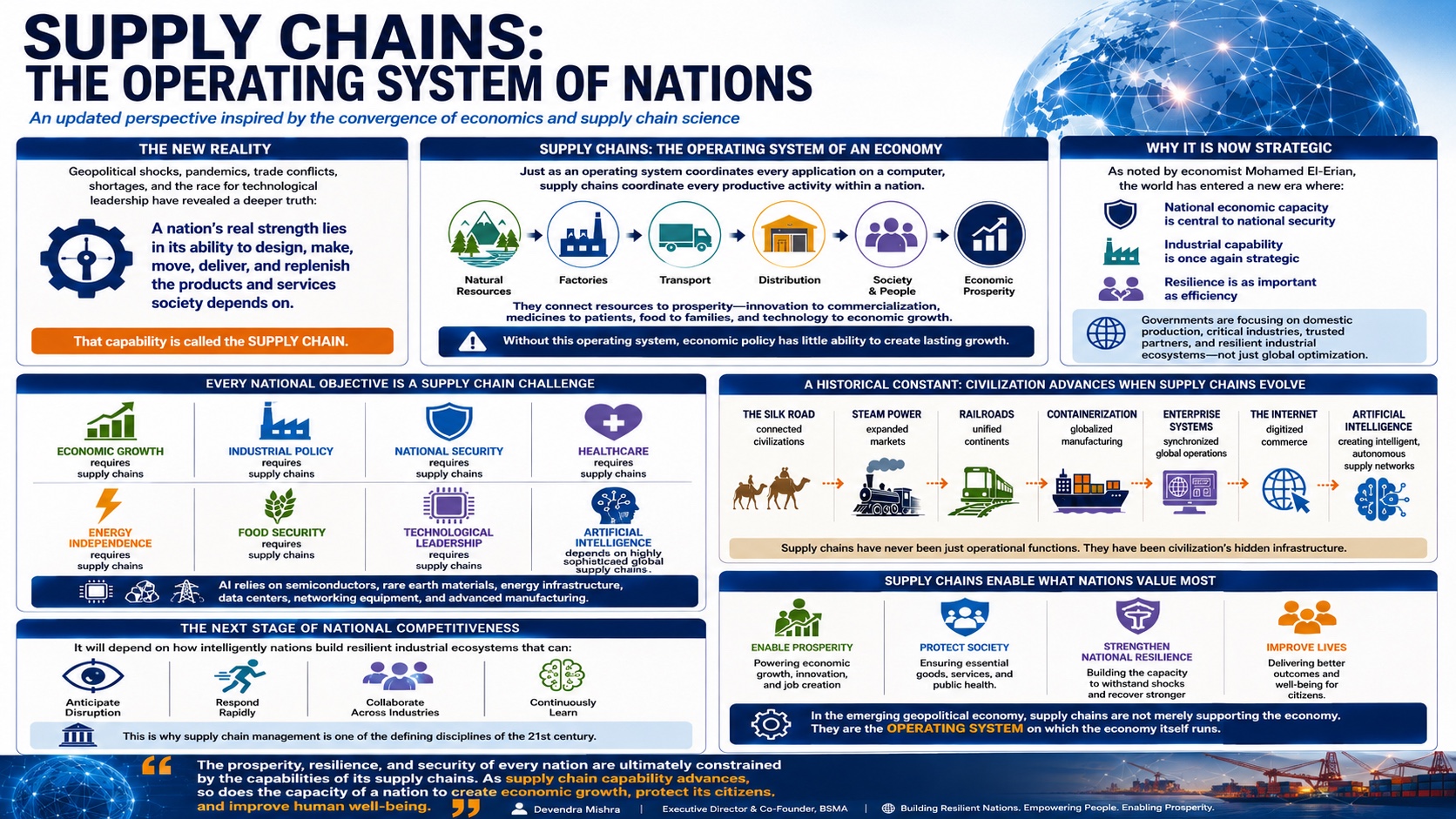
This article argues that supply chains are the Operating System of Nations. They connect resources to production, innovation to commercialization, and products to citizens, enabling every sector of the economy to function. From healthcare and energy to national security and Artificial Intelligence, every strategic objective ultimately becomes a supply chain challenge.
History demonstrates that each major advance in civilization has been accompanied by a transformation in supply chain capability. As nations enter the AI era, competitive advantage will increasingly depend on building intelligent, resilient, and adaptive supply chain ecosystems. The central proposition is simple: the nations that develop superior supply chain capabilities will be best positioned to achieve sustainable prosperity, resilience, technological leadership, and national security in the twenty-first century.
Yet recent geopolitical events, pandemics, trade conflicts, shortages of critical materials, and the race for technological leadership have revealed a deeper reality.
The true strength of a nation lies not simply in what it invents or what it consumes, but in its ability to design, manufacture, transport, distribute, and continuously replenish the products and services upon which society depends. That capability is called the supply chain.
Recent commentary by economist Mohamed El-Erian reinforces this conclusion. He argues that the global economy has entered a new era in which national economic capacity has become central to national security, industrial capability is once again strategic, and resilience has become as important as efficiency. Governments are increasingly focusing on domestic production, critical industries, trusted trading partners, and resilient industrial ecosystems rather than relying solely on global optimization.
Viewed through the lens of supply chain management, these developments are not surprising. Every national objective ultimately becomes a supply chain challenge. Economic growth requires supply chains. Industrial policy requires supply chains. National security requires supply chains. Healthcare requires supply chains. Energy independence requires supply chains. Food security requires supply chains. Technological leadership requires supply chains. Artificial Intelligence itself depends upon highly sophisticated global supply chains for semiconductors, rare earth materials, energy infrastructure, data centers, networking equipment, and advanced manufacturing.
Throughout history, every major leap in civilization has corresponded to a transformation in supply chain capability. The Silk Road connected civilizations. Steam power expanded markets. Railroads unified continents. Containerization globalized manufacturing. Enterprise systems synchronized global operations. The Internet digitized commerce. Artificial Intelligence is now creating intelligent, autonomous supply networks. Each era expanded humanity’s ability to move information, materials, capital, and knowledge more effectively than before. Supply chains have therefore never been merely operational functions. They have been civilization’s hidden infrastructure.
The next stage of national competitiveness will not be determined solely by GDP growth, interest rates, or trade balances. It will increasingly depend upon how intelligently nations build resilient industrial ecosystems capable of anticipating disruption, responding rapidly, collaborating across industries, and continuously learning. This is why I believe supply chain management deserves recognition as one of the defining disciplines of the twenty-first century.
It is no longer simply about moving products. It is about enabling prosperity. It is about protecting society. It is about strengthening national resilience. It is about improving the lives of citizens. In the emerging geopolitical economy, supply chains are not merely supporting the economy. They are the Operating System upon which the economy itself runs.
“The prosperity, resilience, and security of every nation are ultimately constrained by the capabilities of its supply chains. As supply chain capability advances, so does the capacity of a nation to create economic growth, protect its citizens, and improve human well-being.”