


Executive Director & Co-Founder
Bio Supply Management Alliance (BSMA)
Executive Director & Co-Founder
Bio Supply Management Alliance (BSMA)
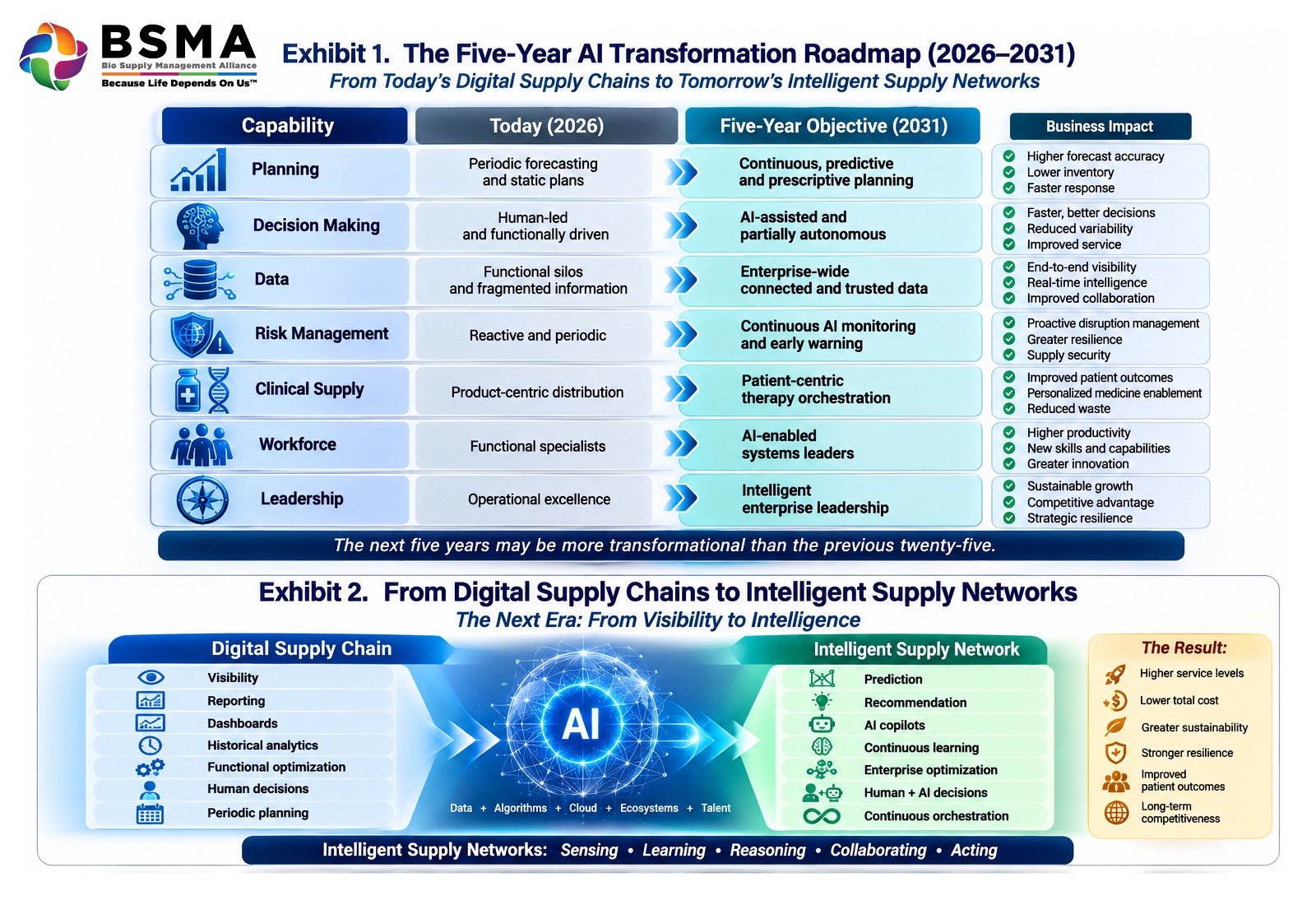
The transition now underway is not from manual work to automation alone. It is from visibility to intelligence, from reactive operations to predictive decision-making, and from isolated functional optimization to connected enterprise ecosystems.
While no one can predict the ultimate trajectory of AI over the coming decade, the direction over the next five years is becoming increasingly clear. Organizations that successfully integrate human expertise with AI-enabled decision support will likely establish competitive advantages that may endure for many years.
Artificial Intelligence presents a similar moment in history. Unlike previous technology waves, AI is evolving at extraordinary speed. No one can confidently describe what supply chain management will look like twenty-five years from now.
Yet there is growing evidence that the next five years will fundamentally reshape how organizations plan, manufacture, transport, and deliver products.
Rather than attempting to predict the distant future, this paper examines the transformations that are already emerging and are likely to redefine supply chain management between now and 2031.
During the next five years we are likely to see increasing adoption of digital platforms that coordinate these networks in real time, allowing organizations to respond more rapidly to disruption while improving collaboration across the ecosystem.
- Anticipate disruptions before they occur
- Evaluate multiple response scenarios
- Recommend optimal actions
- Automate routine operational decisions
- Continuously improve through machine learning
The emphasis is shifting from seeing the supply chain to understanding and improving it. The immediate future is unlikely to be characterized by fully autonomous supply chains. Instead, organizations will increasingly adopt AI-assisted decision making, where AI continuously analyzes data while human professionals retain responsibility for judgment and governance. Routine activities such as demand forecasting, inventory optimization, transportation planning, exception management, supplier monitoring, and risk identification are already becoming candidates for AI augmentation.
- Strategic planning
- Innovation
- Collaboration
- Governance
- Ethics
- Resilience
The role of planners will evolve from managing transactions toward orchestrating intelligent systems.
- Manufacturing
- Transportation
- Suppliers
- Market demand
- Weather
- Geopolitical events
- Regulatory developments
Organizations will increasingly use these models to evaluate alternative scenarios before making major operational decisions, improving both responsiveness and resilience.
Carbon emissions, resource utilization, and supply continuity are increasingly becoming measurable operational variables rather than separate sustainability initiatives. The next five years are likely to see these considerations embedded directly into planning and execution systems.
- Personalized medicine
- Cell and gene therapies
- Molecular diagnostics
- Digital health
- AI-enabled clinical development
We are already requiring new operating models. Rather than managing large volumes of standardized products, healthcare supply chains will increasingly support individualized therapies, faster clinical development, and more direct patient engagement. This represents one of the greatest opportunities for innovation across the entire healthcare ecosystem.
AI excels at processing massive data sets, recognizing patterns, continuous monitoring, and optimization. Over-riding it all will be people responsible for strategic judgment, creativity, ethical reasoning, leadership, collaboration and trust. The organizations that thrive will not necessarily deploy the most AI. They will be those that best integrate human expertise with intelligent technologies.
Governments and industries alike are beginning to recognize that investments in intelligent supply networks are becoming as strategically important as investments in physical infrastructure.
- The Silk Road connected civilizations.
- Ocean trade connected continents.
- Railroads connected nations.
- Containerization connected global commerce.
- The Internet connected information.
- Artificial Intelligence is beginning to connect decision-making itself.
The next five years may represent the beginning of a new chapter in which supply chains evolve from connected information systems into connected intelligence systems.
Organizations that begin today to integrate AI responsibly, strengthen resilience, embrace patient-centric operating models, and invest in intelligent decision-making will be far better positioned for whatever comes next. T
he mission of supply chains remains unchanged. Whether crossing deserts by camel caravan or coordinating global networks through artificial intelligence, supply chains exist for one enduring purpose: To connect human need with human capability. The technologies will continue to evolve. The responsibility of leadership will remain timeless.