
SCM Evolution
Five Transformative Innovations That Changed the Trajectory of Supply Chain Management
By Devendra Mishra
Executive Director & Co-Founder
Bio Supply Management Alliance (BSMA)
By Devendra Mishra
Executive Director & Co-Founder
Bio Supply Management Alliance (BSMA)
Executive Summary
Supply chain management has evolved through centuries of continuous improvement. Yet history shows that only a handful of innovations fundamentally altered the way goods, information, capital, and ultimately value move through society. These breakthrough innovations did more than improve operational efficiency—they redefined the architecture of global commerce and expanded humanity’s capacity to create and deliver economic and societal value.
Introduction
In the last century of the evolution of supply chains, hundreds of innovations have contributed to improvements in efficiency, visibility, reliability, sustainability and resilience. However, a small number of breakthroughs fundamentally altered the trajectory of global commerce and human progress. These innovations did not merely improve existing processes, they redefined how supply chains were designed, managed, and scaled. The following case studies illustrate five transformational milestones whose influence continues to shape modern supply chain management.
Case Study 1: Containerization: The Box That Globalized the World
Background
Before the 1950s, cargo was loaded and unloaded manually at ports. Products were packed in crates, sacks, barrels, and boxes that required extensive labor and handling. Ships frequently spent more time in port than at sea. The process was slow, expensive, and vulnerable to damage and theft.
The Innovation
In 1956, trucking entrepreneur Malcolm McLean introduced the standardized shipping container. The concept was deceptively simple: A uniform steel container could move seamlessly between ships, trucks, and rail systems without unpacking and repacking its contents.
Impact
Containerization revolutionized global trade by:

  • Reducing loading and unloading costs dramatically.
  • Improving transportation speed.
  • Reducing cargo damage.
  • Increasing security.
  • Enabling intermodal transportation.

The standard shipping container became the foundation of modern globalization. Manufacturers could source components globally and distribute products worldwide with unprecedented efficiency.

Lessons for Supply Chain Leaders
The most transformative innovations are often based on simplification and standardization rather than complexity. Containerization demonstrates how a single standard can create value across an entire ecosystem.
Case Study 2: ERP Systems: Creating a Single Source of Truth
Background
During the 1960s and 1970s, companies increasingly struggled to coordinate purchasing, manufacturing, inventory, finance, and distribution activities. Information was fragmented across departments. Decision-making was slow and often based on incomplete and erroneous data. CFOs of global companies wished to speed up quarterly reporting of company financials to Wall Street with reconciliation of numerous currencies.
The Innovation
Material Requirements Planning (MRP) systems, which had become the lifeline of manufacturing, evolved into Enterprise Resource Planning (ERP) platforms capable of integrating information across the enterprise. Organizations such as SAP, Oracle, MS and others created systems that connected operational and financial data through a common architecture. This not only became the backbone of all enterprises, it enabled the establishment of best practices. No system was more demanding of business processes than SAP.
Impact
ERP systems transformed business operations by providing:

  • Integrated planning.
  • Improved inventory management.
  • Financial visibility.
  • Standardized processes.
  • Enterprise-wide data consistency.

For the first time, organizations could view supply chains as integrated systems rather than isolated functions.

Lessons for Supply Chain Leaders
Visibility is a prerequisite for optimization. ERP systems created the digital foundation upon which modern planning, analytics, and Artificial Intelligence solutions are now being built.
Case Study 3: Amazon: Redefining Customer Expectations
Background
Historically, supply chains were designed around manufacturing efficiency and inventory management. Customers adapted to the capabilities of the supply chain.

As a mater of fact, manufacturing was insulated from the marketplace by marketing, distribution and customer service. In addition to the gap with the ultimate customer, there was an inordinate delay in capturing demand signals even after Point of Sale (POS) and UPC barcodes were common practice.

The prominence of the Bull Whip Effect impacted the behavior of the supply chain.

The Innovation
Amazon reversed the equation. Instead of asking customers to adapt to supply chain limitations, Amazon redesigned the supply chain around customer expectations. The company invested heavily in:

  • Fulfillment networks.
  • Advanced inventory positioning.
  • Automation.
  • Predictive analytics.
  • Last-mile delivery capabilities.
Impact
Amazon transformed customer expectations worldwide. Consumers now expect:

  • Rapid fulfillment.
  • Real-time visibility.
  • High service reliability.
  • Seamless digital experiences.

Many organizations have subsequently redesigned their supply chains to compete in an environment defined by speed and transparency.

The economy saw the decline and decimation, in some cases, of the brick and mortar store for many product categories. DVDs, books and toys were some of the early fatalities.

Lessons for Supply Chain Leaders
Competitive advantage increasingly depends on customer experience. Supply chain excellence is no longer measured solely by cost efficiency but also by the value delivered to customers.
Case Study 4: COVID-19 Vaccine Distribution: The Largest Healthcare Supply Chain Mobilization in History
Background
The COVID-19 pandemic created an unprecedented global healthcare emergency. The challenge extended far beyond vaccine development. Billions of doses needed to be manufactured, transported, stored, and administered globally within a compressed time frame. The global marketplace recognizes the vulnerability of the supply chain in saving human lives. The brown-clothed UPS truck driver realized that the urgent and timely delivery of the ventilator to the ICU patient ward of a hospital saved lives.
The Innovation
The response required unprecedented collaboration among:

  • Pharmaceutical companies.
  • Governments.
  • Contract manufacturers.
  • Logistics providers.
  • Regulatory agencies.
  • Healthcare systems.

Advanced cold-chain technologies, global transportation networks, and digital monitoring systems became critical success factors. Last mile delivery became the Achilles Heel which had to be addressed. The century-old EOQ which optimized production or purchase order quantity was revised to include cost of risk, in this case the risk of human lives. Reconfiguration of the supply and delivery network emerged as the new challenge to be overcome.

Impact
The industry successfully demonstrated the ability to:

  • Scale manufacturing rapidly.
  • Manage ultra-low temperature logistics.
  • Coordinate global distribution networks.
  • Accelerate regulatory processes.
  • Deliver life-saving therapies at unprecedented speed.

The vaccine effort highlighted the strategic importance of supply chains in public health.

Lessons for Supply Chain Leaders
Supply chains are not merely economic systems. In healthcare, supply chain performance directly influences patient outcomes and societal well-being. The pandemic elevated supply chain management from an operational discipline to a strategic imperative. Historical success with globalization had to be tempered with a higher degree of responsiveness and resilience.
Case Study 5: AI-Enabled Planning: The Emergence of Intelligent Supply Chains
Background
Traditional planning systems relied heavily on historical data, manual intervention, and periodic review cycles. Powerful statistical tools, simulation and scenario analysis had been developed over the last 75 years. Forecasting errors, demand variability, and supply disruptions often created significant inefficiencies. The causal factors of comprehensiveness of sources of data and their accuracy and real-time nature, corrupted the outcome of the powerful algorithms. After all, planning was carried out to deliver patient healthcare while reducing cost, lead time, waste of assets, and mitigate risk.
The Innovation
Artificial Intelligence introduced new capabilities including:

  • Expanded Data sets – internal and external.
  • Machine learning.
  • Predictive analytics.
  • Natural language processing.
  • Autonomous decision support.
  • Agentic workflows.

Organizations began deploying AI to improve demand forecasting, inventory optimization, supplier risk monitoring, transportation planning, and scenario analysis.

Impact
AI-enabled planning is helping organizations:

  • Improve forecast accuracy.
  • Reduce inventory levels.
  • Detect risks earlier.
  • Optimize logistics networks.
  • Accelerate decision-making.

The industry is transitioning from descriptive and reactive planning toward predictive and prescriptive planning.

Lessons for Supply Chain Leaders
Artificial Intelligence represents more than automation. It marks the transition from digital supply chains to intelligent supply chains. Just as ERP systems became the foundation of enterprise visibility, AI may become the foundation of enterprise decision-making.
Conclusion:
There is a pattern behind transformational innovation.

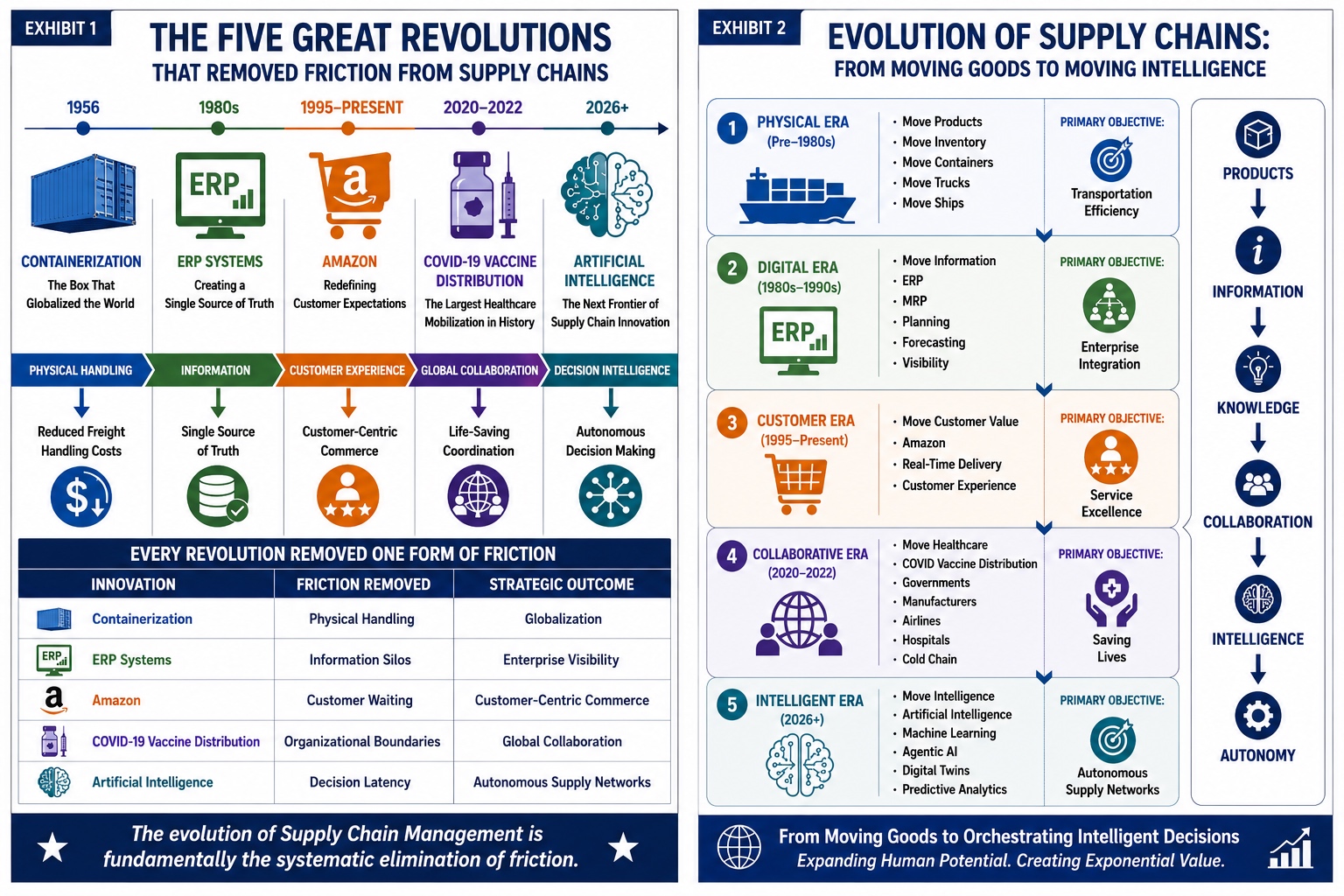
These five innovations occurred across different eras and industries, yet they share a common characteristic. Each reduced a fundamental form of friction:

  • Containerization reduced transportation friction.
  • ERP reduced information friction.
  • Amazon reduced customer-service friction.
  • COVID-19 vaccine distribution reduced collaboration friction.
  • Artificial Intelligence reduces decision-making friction.

This pattern reveals an important truth. The history of supply chain evolution is fundamentally the story of humanity’s effort to reduce friction in the movement of goods, information, capital, knowledge, and increasingly, intelligence itself.

The leaders who recognize and remove the next source of friction will shape the next era of supply chain evolution.

The Five Great Supply Chain Revolutions
Revolution Constraint Removed

Outcome
Containerization

Physical Handling

Global Trade

ERP

Information Silos

Enterprise Visibility

Amazon

Customer Waiting Time

Customer-Centric Commerce

COVID Vaccine Distribution

Organizational Boundaries

Global Health Response

Artificial Intelligence

Decision-Making Limitations

Autonomous Supply Networks

About the Author
Devendra Mishra is Executive Director and Co-Founder of the Bio Supply Management Alliance (BSMA), a global non-profit organization dedicated to advancing patient care through improvements in efficiency, resilience, sustainability, collaboration, and technology across Life Sciences supply chains.
Want to read this later? Download the full article as a PDF to your device.