


Executive Director & Co-Founder
Bio Supply Management Alliance (BSMA)
Executive Director & Co-Founder
Bio Supply Management Alliance (BSMA)
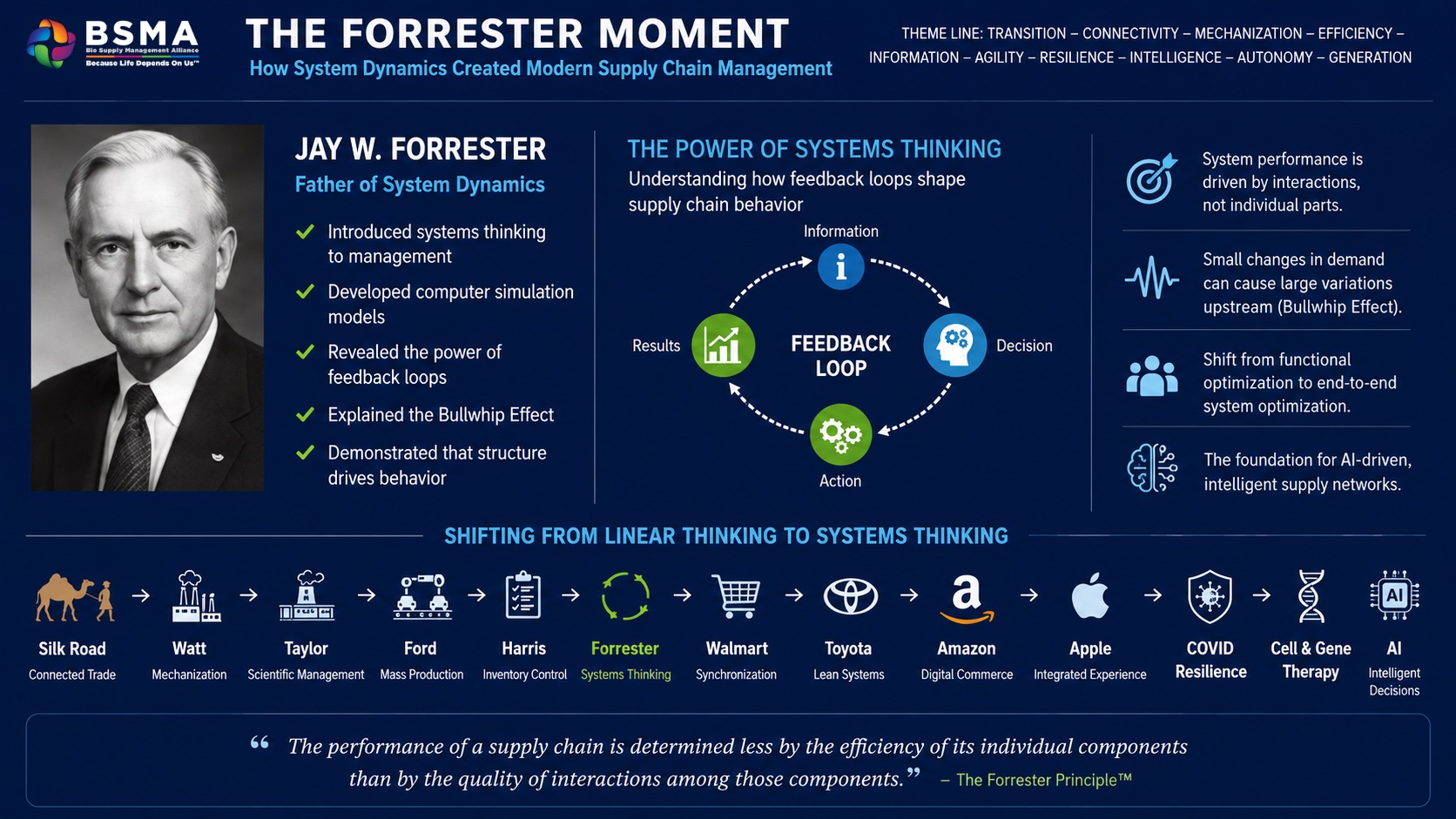
Today, Forrester is widely recognized as the father of System Dynamics. Less appreciated is the profound influence his work has had on modern supply chain management. I recall taking his course 58 years ago for my graduate studies in IE & OR. His guiding principles of Systems Dynamics served as my North Star in my career. Many of the concepts that define contemporary supply chains—including demand amplification, inventory oscillation, end-to-end visibility, and integrated planning—can be traced directly to his pioneering research.
Forrester demonstrated that the performance of a system is determined not by the efficiency of its individual components but by the interactions among those components. This insight fundamentally changed management thinking and laid the intellectual foundation for supply chain management as we know it today.
Transportation sought lower freight costs. Sales sought higher revenue. Each department pursued its own objectives. Yet organizations frequently became less efficient as individual functions improved. Even with the advent of Frederick Winslow Taylor’s (1856-195) principles of Scientific Management, productivity in the American industrial enterprise enhanced economic prosperity but fell far below the potential.
The paradox puzzled executives. How could every function improve while overall performance deteriorated? Forrester argued that managers were focusing on individual parts of a system while ignoring the behavior of the system itself.
He enunciated that a supply chain is not a collection of independent functions. It is a dynamic system of interconnected flows, feedback loops, delays, constraints, and decisions. This became one of the defining insights of modern management.
Managers frequently blamed suppliers, customers, economic conditions, or competitors for poor performance. He demonstrated that the root causes were often embedded within the design of the system itself. The implications were profound that supply chain behavior could be engineered.
But then, demand slows, inventory accumulates, managers reduce production and shortages emerge. This cycle begins again when the demand rebounds. Organizations frequently mistake these self-created oscillations for market volatility. Forrester revealed that instability often originates from delayed reactions within the system itself.
This resultant phenomenon became one of the most important discoveries in supply chain management. The implication was clear that the greatest source of supply chain inefficiency is often poor information flow rather than inadequate physical flow.
Old Questions:
- How do we reduce procurement costs?
- How do we increase factory utilization?
- How do we lower transportation expenses?
New Questions:
- How do decisions affect the entire network?
- How do information delays influence behavior?
- How do incentives create unintended consequences?
- How do we optimize end-to-end performance?
This transition marked the birth of modern supply chain management.
The behavior of these systems is still governed by feedback loops, information delays, decision policies. resource constraints and dynamic interactions. In many respects, modern supply chains have become the living embodiment of Forrester’s theories.
These capabilities address the very challenges that Forrester identified decades ago. If Forrester provided the science for understanding system behavior, Artificial Intelligence may provide the capability to manage that behavior in real time.
The progression is remarkably logical – Taylor optimized work, Ford optimized production, Harris optimized inventory, Forrester optimized systems, Walmart optimized synchronization, and Amazon optimized digital commerce.
“The performance of a supply chain is determined less by the efficiency of its individual components than by the quality of interactions among those components.”
This principle explains why supply chains succeed or fail. It also explains why Artificial Intelligence, visibility, collaboration, and end-to-end integration will become the defining capabilities of future enterprises.
Sixty-five years after the publication of Industrial Dynamics in 1961, the principles he introduced continue to shape supply chain management. The modern supply chain is, in many ways, a practical application of Forrester’s ideas.
As organizations move toward autonomous and intelligent supply networks, the importance of his insights will only grow. History may ultimately recognize Jay Forrester not merely as the father of System Dynamics, but as one of the principal architects of modern supply chain management.
Silk Road → Watt → Taylor → Ford → Harris → Forrester → Walmart → Toyota → Amazon → Apple → COVID Resilience → Cell & Gene Therapy → AI