
SCM Evolution
How Has the Evolution of Supply Chains Advanced Nations and Economies?
From Silk Roads to Artificial Intelligence: How 750 Years of Supply Chain Evolution Shaped Civilization and Will Define the Future of Healthcare
By Devendra Mishra
Executive Director & Co-Founder
Bio Supply Management Alliance (BSMA)
By Devendra Mishra
Executive Director & Co-Founder
Bio Supply Management Alliance (BSMA)
Abstract
The history of civilization is often told through wars, governments, scientific discoveries, and technological breakthroughs. Yet an equally compelling narrative exists in the evolution of supply chains.

From the Silk Road traversed by Marco Polo in the thirteenth century to the emergence of Artificial Intelligence in the twenty-first century, advances in supply chain capabilities have enabled economic growth, social progress, globalization, and improved quality of life.

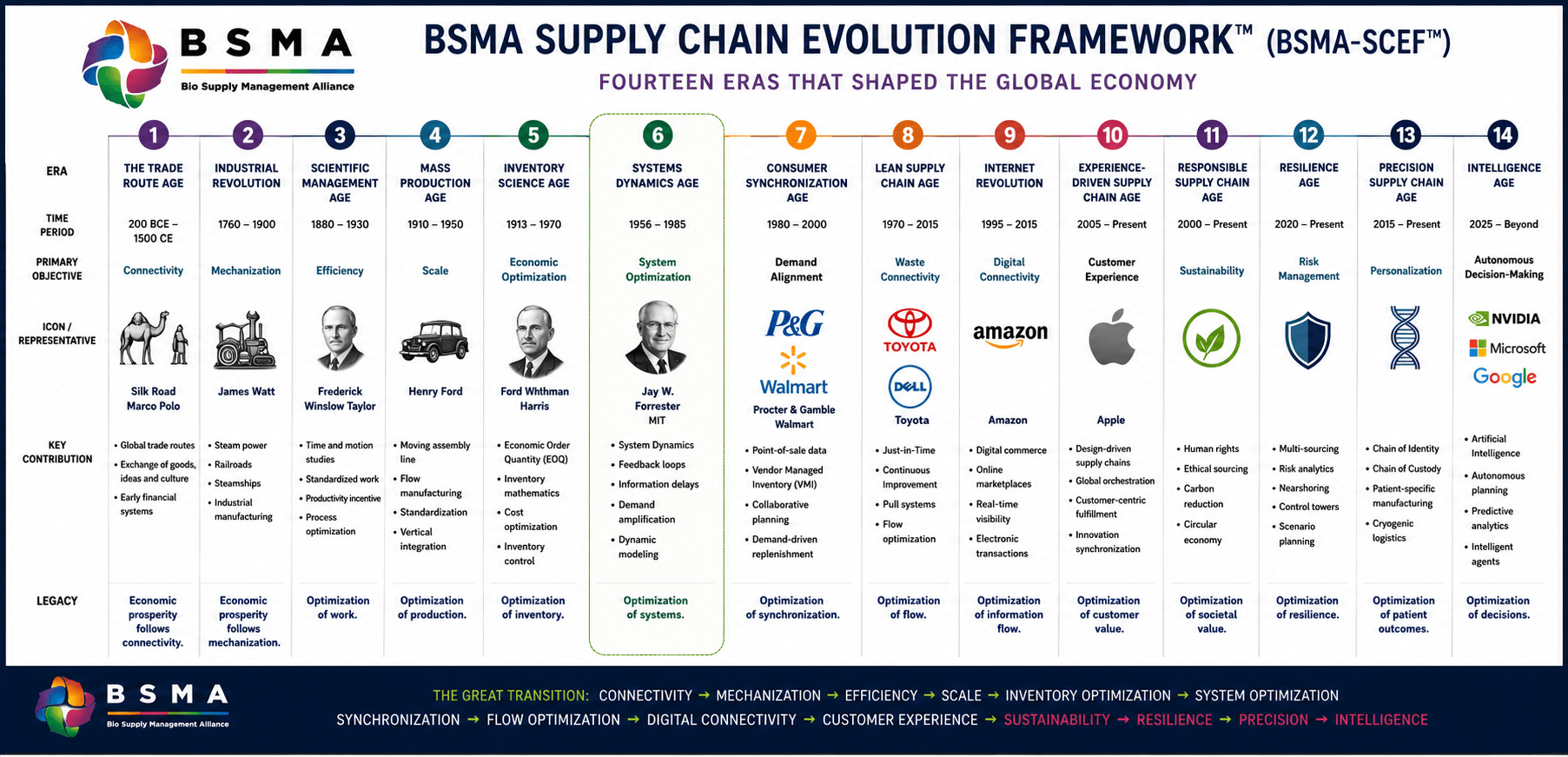
This paper introduces the BSMA Supply Chain Evolution Framework™, which identifies fourteen major eras in the development of supply chains over the past 750 years. The framework demonstrates how innovations in transportation, communication, standardization, information management, and intelligent decision-making progressively reduced distance, uncertainty, cost, and time.

The paper argues that supply chain evolution has been one of the primary drivers of human progress and that Artificial Intelligence represents the most transformative chapter yet. For the Life Sciences and Healthcare industries, the implications are profound. Supply chains no longer merely support business operations; they directly influence patient outcomes, global health resilience, and access to life-saving therapies.

Introduction
Supply chains are often viewed as operational systems responsible for moving products from suppliers to customers. Such a narrow definition understates their historical significance.

At their core, supply chains are the mechanisms through which societies organize the movement of goods, information, people, capital, and knowledge. They connect producers with consumers, innovation with adoption, and resources with need.

Throughout history, every major expansion in human prosperity has been accompanied by a corresponding improvement in supply chain capability.

  • The Silk Road connected civilizations.
  • Ocean trade connected continents.
  • Railroads connected nations.
  • Containerization connected global economies.
  • The Internet connected information.
  • Artificial Intelligence now promises to connect intelligence itself.

Understanding this progression provides valuable insight into both the history and future of supply chain management.

The Fourteen Eras of Supply Chain Evolution
Era 1: The Silk Road (1271–1450)
Marco Polo’s journey symbolized the emergence of long-distance trade networks connecting Asia, the Middle East, and Europe. For the first time, products, cultures, technologies, and ideas flowed across continents through an integrated trade ecosystem. The supply chain became a vehicle for globalization long before the term existed.
Era 2: The Age of Exploration (1450–1700)
Maritime exploration dramatically expanded global trade routes. Supply chains evolved from regional networks into international systems capable of supporting commerce across oceans.
Era 3: Mercantilism and Colonial Trade (1600–1800)
Trade became increasingly organized through commercial enterprises and colonial structures. Supply chains began supporting large-scale resource extraction and international commerce.
Era 4: The Industrial Revolution (1760–1850)
Mechanized manufacturing transformed production capacity. Supply chains evolved to synchronize raw materials, factories, labor, and distribution channels.
Era 5: Railroads and Steamships (1830–1900)
Transportation speed and reliability improved dramatically. Geographic barriers that had constrained economic growth for centuries began to disappear.
Era 6: Scientific Management and Standardization (1900–1945)
Industrial leaders introduced process discipline, measurement systems, and operational optimization. Efficiency became a competitive advantage.
Era 7: The Pallet and Material Handling Revolution (1930–1960)
One of the most influential innovations in supply chain history emerged in the form of a simple wooden platform: the 42” × 48” pallet. Standardization enabled dramatic improvements in handling efficiency, warehousing, and transportation productivity. The pallet became a symbol of simplification driving exponential value.
Era 8: Containerization (1956–1980)
Standard shipping containers transformed global logistics. Products could move seamlessly between ships, trucks, and railroads without repeated handling. Containerization accelerated globalization and reduced transportation costs worldwide.
Era 9: Enterprise Planning Systems (1970–1995)
MRP, ERP, and integrated planning systems introduced digital visibility into supply chain operations. Information became as important as inventory.
Era 10: Globalization and Outsourcing (1980–2005)
Companies optimized supply networks across continents. Supply chains evolved into highly interconnected global ecosystems.
Era 11: The Internet and E-Commerce (1995–2010)
Digital connectivity revolutionized communication and customer expectations. Information moved instantly, enabling unprecedented coordination.
Era 12: Cloud Computing and Digital Platforms (2010–2020)
Organizations gained access to scalable data and collaborative technologies. Supply chains became increasingly visible and interconnected.
Era 13: Digital Twins and Intelligent Networks (2018–Present)
Advanced analytics, simulation models, and real-time visibility enabled predictive decision-making. Organizations began shifting from reactive management to proactive orchestration.
Era 14: Artificial Intelligence and Autonomous Supply Chains (2023–Future)
Artificial Intelligence represents a fundamental shift. Unlike previous technologies that automated tasks, AI augments decision-making itself.

AI can predict disruptions, optimize inventory, orchestrate logistics, automate planning, and provide real-time recommendations across the entire supply chain ecosystem.

The Evolution of Human Connectivity
A broader pattern emerges when these eras are viewed collectively. Supply chain evolution is fundamentally the story of increasing connectivity.

  • Silk Road: Connected civilizations.
  • Ocean Trade: Connected continents.
  • Railroads: Connected nations.
  • Containerization: Connected economies.
  • Internet: Connected information.
  • Artificial Intelligence: Connected intelligence.

Each era reduced friction and expanded humanity’s ability to collaborate, trade, innovate, and prosper.

Why Supply Chains Matter More Than Ever
Recent disruptions exposed the strategic importance of supply chains. Pandemics, geopolitical tensions, natural disasters, and shortages demonstrated that resilient supply chains are essential to economic stability and public well-being.

Supply chain management has evolved from an operational function into a boardroom priority. Organizations increasingly recognize that competitive advantage depends upon visibility, resilience, agility, and sustainability.

The Special Responsibility of Healthcare Supply Chains
Nowhere is supply chain performance more important than in healthcare and life sciences. After all, human life depends on flawless execution in the supply chain. A manufacturing delay can postpone a clinical trial.

A transportation failure can compromise a temperature-sensitive therapy. A sourcing disruption can delay patient access to critical medicines. In healthcare, supply chains do not merely create economic value. They create human value. They save lives.

The future healthcare supply chain must integrate scientific innovation, manufacturing excellence, logistics capability, regulatory compliance, digital technology, and artificial intelligence into a seamless patient-centered ecosystem.

The Age of Artificial Intelligence
Artificial Intelligence represents more than another technological advancement. It is the first technology capable of continuously learning from data and assisting human decision-makers at scale.

Future supply chains may become:

  • Predictive rather than reactive.
  • Autonomous rather than manually controlled.
  • Self-optimizing rather than periodically adjusted.
  • Patient-centric rather than product-centric.

The result will be unprecedented improvements in efficiency, resilience, sustainability, and service.

Conclusion
For more than seven centuries, supply chains have enabled the expansion of civilization. Their evolution mirrors humanity’s pursuit of greater connectivity, efficiency, and prosperity.

From camel caravans crossing deserts to AI agents optimizing global networks, the objective remains unchanged: delivering the right product, to the right place, at the right time. What has changed is the scale, speed, and intelligence with which that objective can be achieved.

As we enter the era of Artificial Intelligence, supply chain leaders have a unique opportunity—and responsibility—to shape the next chapter of human progress. The future of civilization may depend not only on what we invent, but on how effectively we deliver those innovations to the people who need them most.

About the Author
Devendra Mishra is Executive Director and Co-Founder of the Bio Supply Management Alliance (BSMA), a global non-profit organization dedicated to advancing patient care through improvements in efficiency, resilience, sustainability, collaboration, and technology across Life Sciences supply chains.
Want to read this later? Download the full article as a PDF to your device.