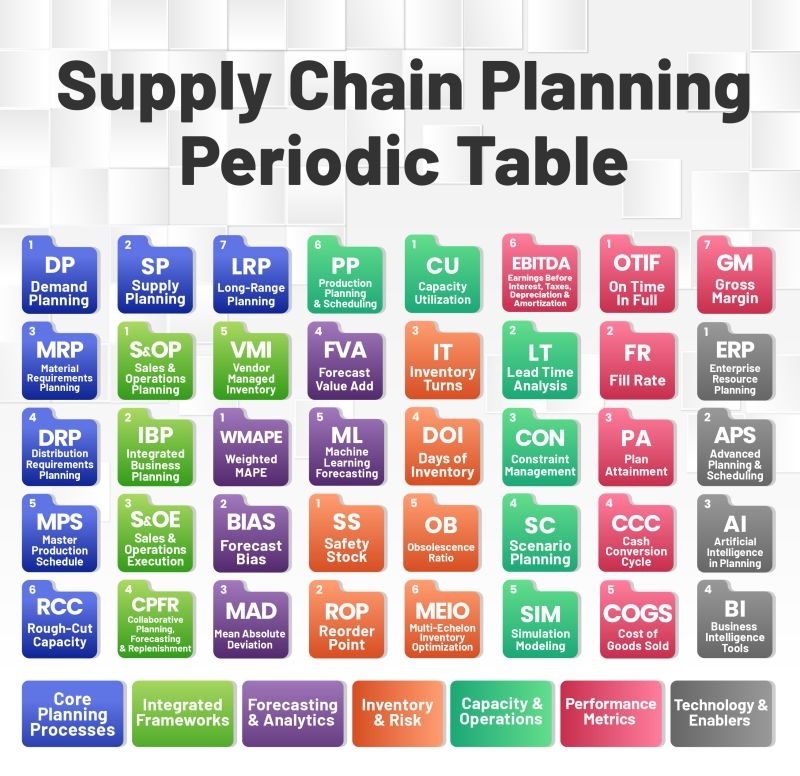
Supply chain planning is as much an art as it is a science. To master it, one must balance demand, supply, capacity, risk, and performance while ensuring seamless execution across global networks. Just like chemistry, every element plays a critical role—and when combined correctly, they form a resilient, high-performing supply chain.
Recently, Marcia D William shared a creative infographic on LinkedIn that compares supply chain planning to the periodic table. Inspired by that framework, we’re breaking down the elements here to highlight the essential concepts, metrics, and enablers that shape the future of supply chain management.
Core Planning Processes
These are the backbone of every planning cycle:
• DP – Demand Planning: Anticipating customer demand with precision.
• SP – Supply Planning: Aligning resources to meet demand effectively.
• MRP – Material Requirements Planning: Ensuring raw materials and components are available when needed.
• DRP – Distribution Requirements Planning: Coordinating product movement across networks.
• MPS – Master Production Schedule: Translating demand into detailed production plans.
• RCC – Rough-Cut Capacity: Assessing feasibility at an aggregate level.
• LRP – Long-Range Planning: Strategizing for the future, not just today.
Integrated Frameworks
True supply chain excellence requires integration across functions:
• S&OP – Sales & Operations Planning: Balancing demand and supply at a tactical level.
• IBP – Integrated Business Planning: Extending S&OP to financial and strategic alignment.
• S&OE – Sales & Operations Execution: Bridging plans with real-time execution.
• CPFR – Collaborative Planning, Forecasting & Replenishment: Enhancing visibility with trading partners.
• VMI – Vendor Managed Inventory: Shifting responsibility upstream to suppliers.
Forecasting & Analytics
Data-driven decision making depends on the right metrics and tools:
• WMAPE – Weighted MAPE: Measuring forecast accuracy fairly across SKUs.
• BIAS – Forecast Bias: Identifying over- or under-forecasting tendencies.
• MAD – Mean Absolute Deviation: Quantifying forecast error.
• FVA – Forecast Value Add: Evaluating whether forecasting efforts truly improve outcomes.
• ML – Machine Learning Forecasting: Leveraging AI to enhance accuracy.
Inventory & Risk
Managing buffers and uncertainty is critical:
• SS – Safety Stock: Protecting against variability.
• ROP – Reorder Point: Triggering replenishment at the right time.
• IT – Inventory Turns: Measuring efficiency of stock usage.
• DOI – Days of Inventory: Understanding cash tied up in stock.
• OB – Obsolescence Ratio: Avoiding excess and waste.
• MEIO – Multi-Echelon Inventory Optimization: Balancing stock across the network.
Capacity & Operations
Where strategy meets execution:
• CU – Capacity Utilization: Maximizing assets without bottlenecks.
• LT – Lead Time Analysis: Understanding responsiveness.
• CON – Constraint Management: Identifying and addressing the weakest links.
• SC – Scenario Planning: Preparing for multiple futures.
• SIM – Simulation Modeling: Stress-testing operations before execution.
• PP – Production Planning & Scheduling: Turning plans into actionable shop-floor instructions.
Performance Metrics
What gets measured, gets managed:
• OTIF – On Time In Full: Delivering reliability.
• FR – Fill Rate: Meeting customer demand without backorders.
• PA – Plan Attainment: Tracking adherence to plans.
• CCC – Cash Conversion Cycle: Measuring financial efficiency.
• COGS – Cost of Goods Sold: Evaluating production and procurement costs.
• EBITDA – Earnings Before Interest, Taxes, Depreciation & Amortization: Assessing profitability.
• GM – Gross Margin: Gauging financial health.
Technology & Enablers
The digital foundation of modern supply chains:
• ERP – Enterprise Resource Planning: Integrating business functions.
• APS – Advanced Planning & Scheduling: Enhancing planning precision.
• AI – Artificial Intelligence in Planning: Unlocking smarter decisions.
• BI – Business Intelligence Tools: Turning data into insights.
Why This Matters
Just as chemists rely on the periodic table to understand elements and their interactions, supply chain professionals can use this framework to visualize the interplay of planning components. Together, these building blocks create a system that is adaptive, resilient, and capable of driving both efficiency and innovation.
At BSMA, we believe supply chain leaders must not only know each element but also understand how to connect them to achieve sustainable success.
⸻
📌 Author Note:
This article was inspired by a LinkedIn post from Marcia D William, who creatively reimagined supply chain planning as a periodic table. BSMA is sharing this framework to further the conversation and highlight its value to the global supply chain community.